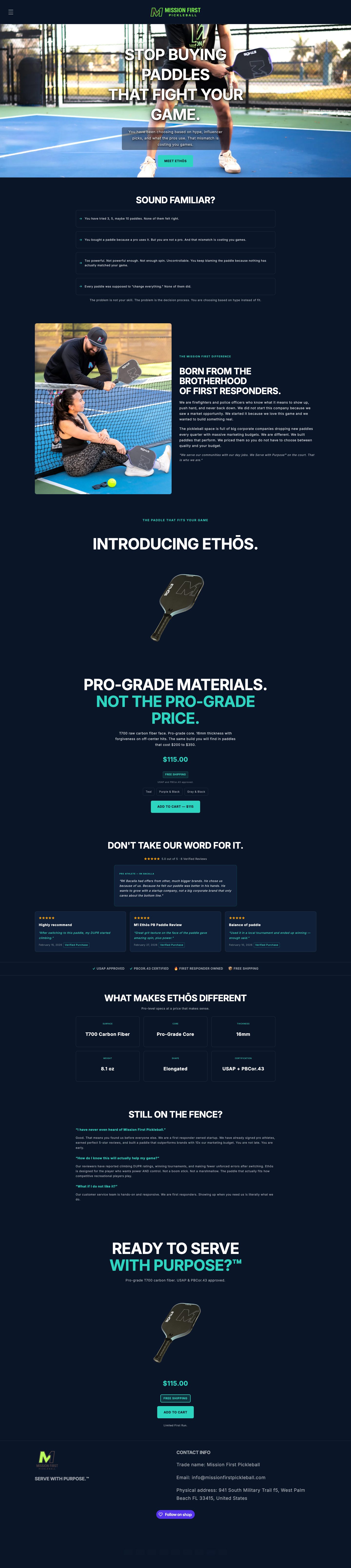
Rebuilding MFP's Shopify from zero.
A full storefront rebuild and an AI content engine that produced weeks of assets in under a week. This is the build log. Every decision, every screen, in order.
A new brand with a real mission, and a site that was going to burn ad budget.
Mission First Pickleball is a first responder owned paddle and apparel brand. The founders actually play the game, and they built the company around a simple idea. Serve communities with their day jobs. Serve with purpose on the court.
They came to us the way good clients usually do. One of the partners was already a long time client on another brand, so when they launched MFP with their team, they wanted the same agency running marketing and ads. The trust was already there.
The brief itself was straightforward. Launch phase. New paddle line starting at $115. A second pro level paddle dropping in April at $150, a third later at $199. Revenue goal starts modest and scales with inventory. Target audience is the pickleball player who is done dabbling. They want a brand to believe in, not another hype paddle.
There was one problem. The site they wanted us to send ad traffic to was not going to convert.
Fix the store before spending a dollar on traffic.
Before we spent a dollar on ads we audited the store the founders had stood up. The post click flow was broken. Products were hard to browse. There were no real product pages, no clear buy buttons, no about section telling the brand story. Nothing on that site was doing the job ads were about to send people to do.
We made the call on the phone. We could run ads, but with a brand new brand plus a weak site, that is a losing battle on conversions. Every dollar of ad spend would be fighting two fights at once. The smarter move was to rebuild the store from scratch, then turn traffic on.
Thirty minutes later we sent back a mockup. Brand story front and center. Colors dialed in. Visually different from every other pickleball paddle brand on the market. The mockup ended the conversation. No pushback. No debate on timeline. We were off to the races.
Every page, every decision, in order.
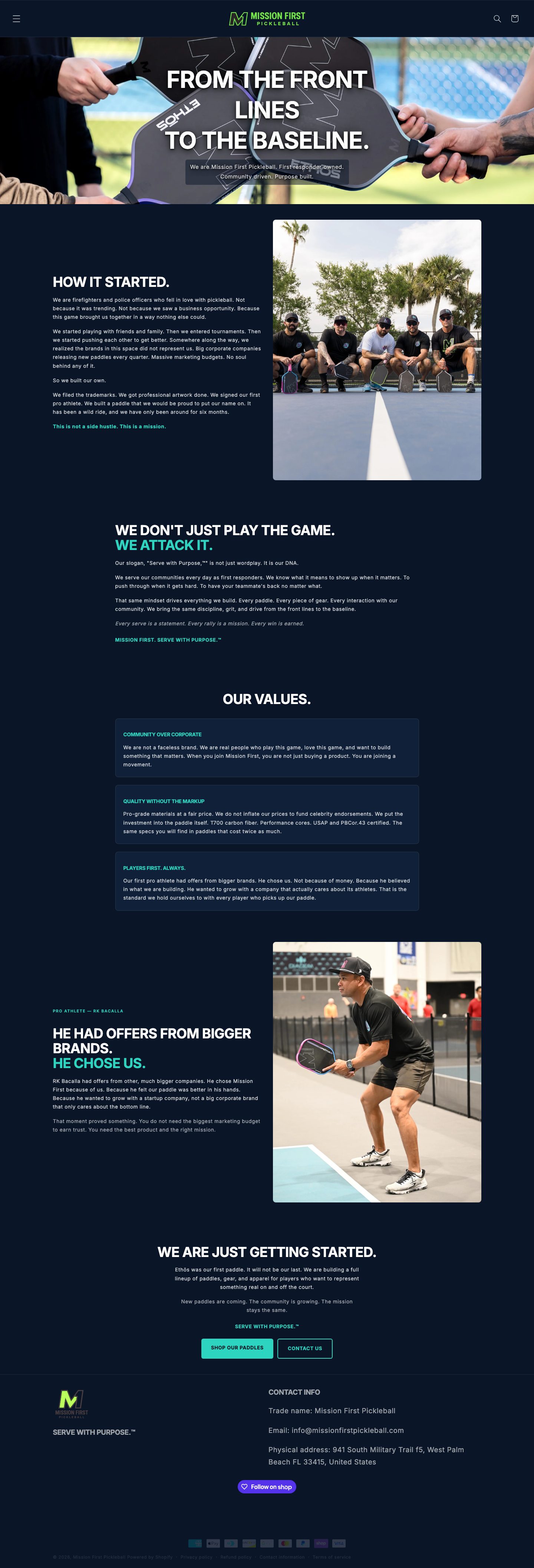
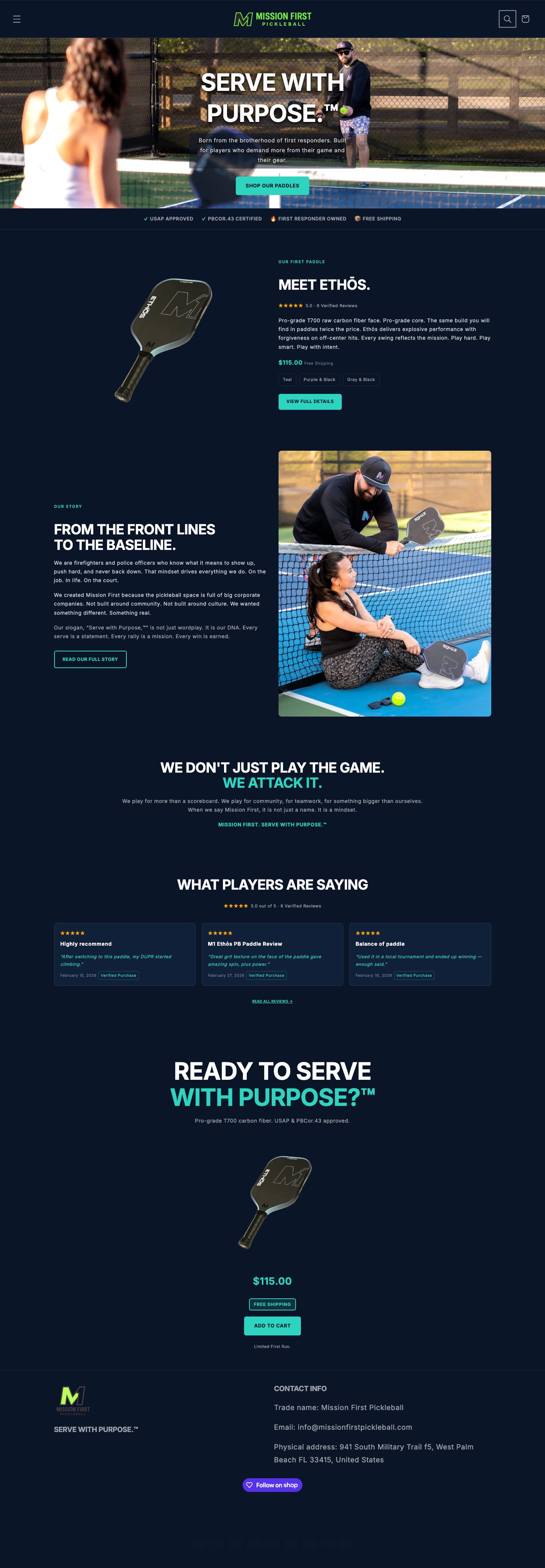
The rebuild was a full Shopify store. Homepage, product page, collection page, about, contact, ad landing page, blog. Eight pages, wired together on a theme we customized heavily so MFP did not look like another Dawn clone.
We did not stop at the storefront. We built out the post visit experience too. A Klaviyo popup opt in on the homepage captures email before first time visitors leave. A PostScript SMS sequence is wired into the same flow so subscribers land in both channels without stepping on each other. Every new lead goes into a welcome sequence that keeps them engaged after the first click, before the first purchase, and through every launch after that.
There was no dramatic crisis during the build. Every page had its own tuning. Fonts, layout, image crops, how the copy landed in context. It is easy to make something good. We fine tuned it to make it great. Then we pushed traffic and kept iterating.
The fastest way to see what changed is to look at the before and after. The old store on the left. The new one on the right.
Every piece of content is downstream of this.
Before the first page of copy got written, we ran MFP through our intake system. The Gravity Converter Formula pulls 55 questions out of the founder. Those answers become the Intelligence Brief. The brief becomes the Brand Voice Profile. The voice profile plus the founder's answers become the Avatar Map.
By the time we opened a Shopify theme we already knew who MFP was for, how they talked, what words they used, what they would never say, what their customer was afraid of, and what that customer was trying to become. This is the difference between a case study and a template. Every sentence you read on the rebuilt site is traceable to a line in one of these three documents.
Voice DNA
The Customer's Real Fear
It literally answers everything. It gives me everything I need.
— Matt Holmes, HMFIC Marketing
A month of work, shipped in under a week.
Once the intelligence layer is in place, the engine can run. The engine does not write generic copy. It writes from the brief, in the voice profile, aimed at the avatar's actual pains. Volume and consistency both come from the same source.
Here is what shipped for MFP alongside the Shopify rebuild. Eight site pages. Seven SEO blog posts. Four themed weeks of social content. Two reel storyboards. Three cold ad creative concepts. Three direct response Meta ad sets. A six email nurture sequence. Roughly 33 named deliverables before you count the individual posts inside each week.
Traditional timeline for this scope is about a month. We delivered in under a week. Cost is the other half of the story. From the site to the content to the ads, all of it, you are looking at $7,000 to $10,000 up front plus a monthly retainer at most good agencies. The engine is what makes the math work for MFP.
5 Signs You're Playing the Wrong Paddle
An educational SEO post written in the MFP voice. Targets the daily frustration pulled straight from the Avatar Map. Positions the Ethos paddle without selling it.
A Pro Chose Us
30 second social reel. Opens on a sponsored player, cuts to the brand story, closes on a mission first call to action. Fully storyboarded shot by shot.
From the Front Lines to the Baseline
Nurture sequence email that tells the founder story without sounding like every other DTC founder story email. Uses verbal fingerprints from the voice profile.
Pain Lead Cold
Meta ad concept written against the costly mistake pain. Hook, mechanism, proof, CTA. Ready for production.
Launch phase. Traffic on. Data coming.
MFP is in its initial launch phase as of April 2026. The store is live. The content engine is running. Email and SMS flows are layered on top of the live store and collecting subscribers.
What we are watching right now is the honest stuff. Engagement growth, traffic, sales. Not vanity metrics. The loop is simple. Drive traffic, analyze the data, find what needs to improve, iterate, grow.
When real numbers land we will add a results update chapter to this build log. No overclaiming before the data earns it.
If you run a Shopify store and this is the kind of work you want done for you, let's talk.
One call. We look at your store, tell you straight whether it is ready for traffic, and if it is not, we tell you exactly what it will take to get there. No pitch deck. No sales rodeo. Just a real answer from someone who has done the work.